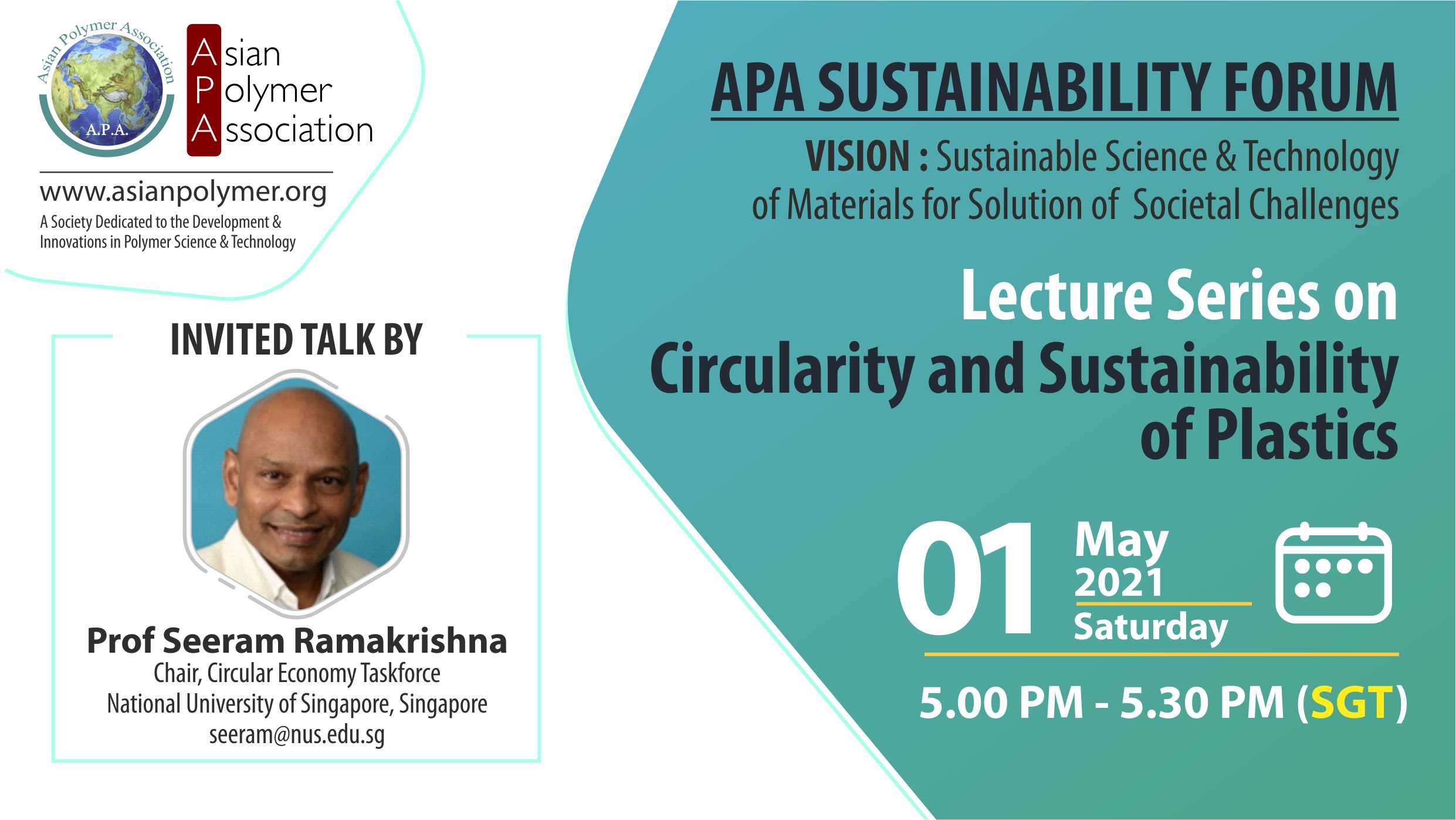
Bio:
Seeram Ramakrishna, FREng, Everest Chair is a professor and Director of Center for Nanotechnology & Sustainability at the National University of Singapore (NUS). He is a Member of UNESCO Expert Group on Universities and the 2030 Sustainability Agenda. He is also a member of Enterprise Singapore’s and ISO’s Committees on ISO/TC323 Circular Economy and WG3 on Circularity; and Environmental, Social and Governance (ESG) committee of Singapore Institute of Directors. He is a Vice-President of Asian Polymer Association (https://www.asianpolymer.org/committee.html). He is a Founding Member of Plastics Recycling Association of Singapore, PRAS (https://www.sgc.org.sg/events/event-details/sgc-sustainability-committee-and-pras) and Director designate of Center of Excellence, PRCOE. He received PhD from the University of Cambridge, UK; and GMP from Harvard University, USA. His Google Scholar shows over 121,300 citations, ~ 160 H index, and over 1018 i10-index. He is a highly cited researcher in the world in materials science as well as cross-field categories. Thomson Reuters recognized Professor Seeram as one of the World's Most Influential Scientific Minds. European Commission Director-General for Environment, Excellency Daniel Calleja Crespo said “Professor Seeram Ramakrishna should be praised for his personal engagement leading the reflections on how to develop a more sustainable future for all” in his foreword for the Springer Nature book An Introduction to Circular Economy (https://link.springer.com/book/10.1007/978-981-15-8510-4).
Webinar Date & Time: Saturday May 1, 5pm SGT (Singapore Time)
Webinar Title: Circularity and Sustainability of Plastics
Registration : Click here
Abstract: Worldwide consensus is building up in recent years for greater sustainability while there is no clear strategy on how sustainability friendly public policy goals are to be achieved. On this backdrop, plastics are seen as both a hero and a villain. They have played an integral role in shaping our modern society. The global primary plastic production reached 368 Mt in 2018, and it is projected to reach 900 Mt by 2050. On the other hand, plastic wastes are accumulating around the world. Evidences are being piled up on their environmental as well as health hazards associated with the end of life management. This lecture seeks to address questions such as why only a tiny fraction of plastics is recycled sustainably; what are the end of life plastic waste management practices; what are the emerging market mechanisms & incentives, regulations & penalties, and international agreements & standards aimed at facilitating circularity & sustainability of plastics; and what more needs to be done in reducing the sustainability gap.